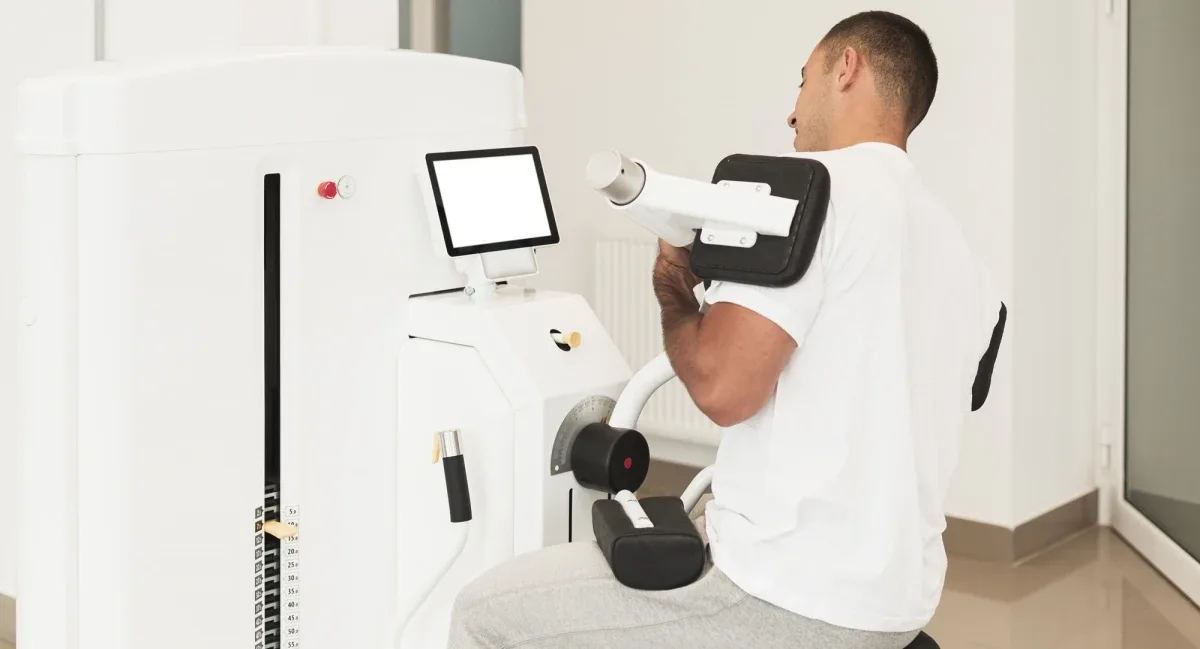
Combined Robotic and Conventional Rehabilitation in Stroke Recovery
In recent years, robotic rehabilitation devices have increasingly been used in the treatment of stroke and other neurological disorders. These high-technology systems enhance patient motivation, provide objective measurements, and allow intensive repetition of movements. However, an important question remains: Is robotic rehabilitation alone sufficient?
When we look at the history of rehabilitation, conventional rehabilitation methods, which have a much longer history than robotic rehabilitation, have helped patients regain a certain level of function, but they also have several limitations. Fatigue experienced by both therapists and patients, as well as time constraints, make it difficult to maintain the required intensity and repetition levels consistently (1). Considering the functional loss and muscle weakness that often occur in the limbs after stroke, patients may experience physical exhaustion in a short time during walking training and upper limb exercises performed with conventional methods. This situation may negatively affect both the effectiveness of rehabilitation and adherence to treatment (2).
Robotic rehabilitation helps reshape neural networks in the brain through structured and repetitive movements. Sessions that can be sustained for longer periods due to robotic assistance and increased motivation further strengthen this effect compared with conventional rehabilitation (3). However, each patient has different needs. Therefore, the exercise program should be individually planned, starting at a level the patient can tolerate and gradually increasing in intensity (2).
Effect of Robotic Rehabilitation on Walking Function
Recent research shows that robot-assisted gait training significantly improves motor function, balance, and walking ability after stroke. However, its effect on walking coordination remains limited (2).
Walking coordination refers to the correct sequencing, synchronization, and rhythm of movements of the ankle, knee, hip, and pelvis together with the trunk and upper extremities. After stroke, common conditions such as increased muscle tone (spasticity), muscle weakness, and sensory deficits may disrupt this coordination.
As a result, step length and walking speed may decrease, coordination between the right and left legs may be lost, and the normal gait pattern (heel strike – mid-foot – toe off) may change. Therefore, robotic rehabilitation alone is not sufficient to restore walking coordination.
When combined with targeted conventional physiotherapy and occupational therapy methods, robotic rehabilitation produces much more effective outcomes and facilitates the transfer of functional gains into daily life activities.
Upper Limb Rehabilitation
Studies focusing on improving hand and arm function after stroke have shown that combining conventional rehabilitation methods with robotic rehabilitation leads to better results in improving motor skills and independence in daily activities compared with using robotic therapy alone.
Conclusion
Although robotic rehabilitation contributes significantly to intensive repetition and motor learning through its game-based structure and task-oriented systems, it may be insufficient on its own when it comes to integrating these gains into daily life. At this point, conventional physiotherapy and occupational therapy play a critical role in transferring acquired motor skills into functional activities and everyday tasks.
Examples of Exercises That Transfer Motor Skills to Daily Life
- For safely standing up from a chair, sit-to-stand practice should be repeated at different seat heights.
- To improve stair-climbing ability, step training should be performed on step-like surfaces.
- To step over a high obstacle, step-over exercises using therapy equipment should be practiced.
- To improve walking uphill or downhill, walking exercises on inclined surfaces should be included.
- To hold a pen more accurately and with better control, pen-based exercises should be integrated into therapy sessions.
- To button a shirt or zip a zipper, fine motor skill exercises involving daily living activities should be incorporated.
- To carry shopping bags or other loads, balance and load-carrying exercises should be practiced.
Therefore, combining the intensive repetition and motivation provided by robotic rehabilitation with real-life functional activities is essential to ensure that recovery becomes sustainable, functional, and meaningful.
References
1. Park JM, Park HJ, Yoon SY, Kim YW, Shin JI, Lee SC. Effects of Robot-Assisted Therapy for Upper Limb Rehabilitation After Stroke: An Umbrella Review of Systematic Reviews. Stroke. 2025.
2. Wang H, Shen H, Han Y, Zhou W, Wang J. Effect of robot-assisted training for lower limb rehabilitation on lower limb function in stroke patients: a systematic review and meta-analysis. Front Hum Neurosci. 2025.
3. Wang D, Huang Y, Liang S, Meng Q, Yu H. The identification of interacting brain networks during robot-assisted training with multimodal stimulation. J Neural Eng. 2023.